
How long does planning permission take in County Durham?
Most householder applications in England are meant to be decided within eight weeks. Here is what happens to your application in that time, why it often takes longer, and what you can do about it.
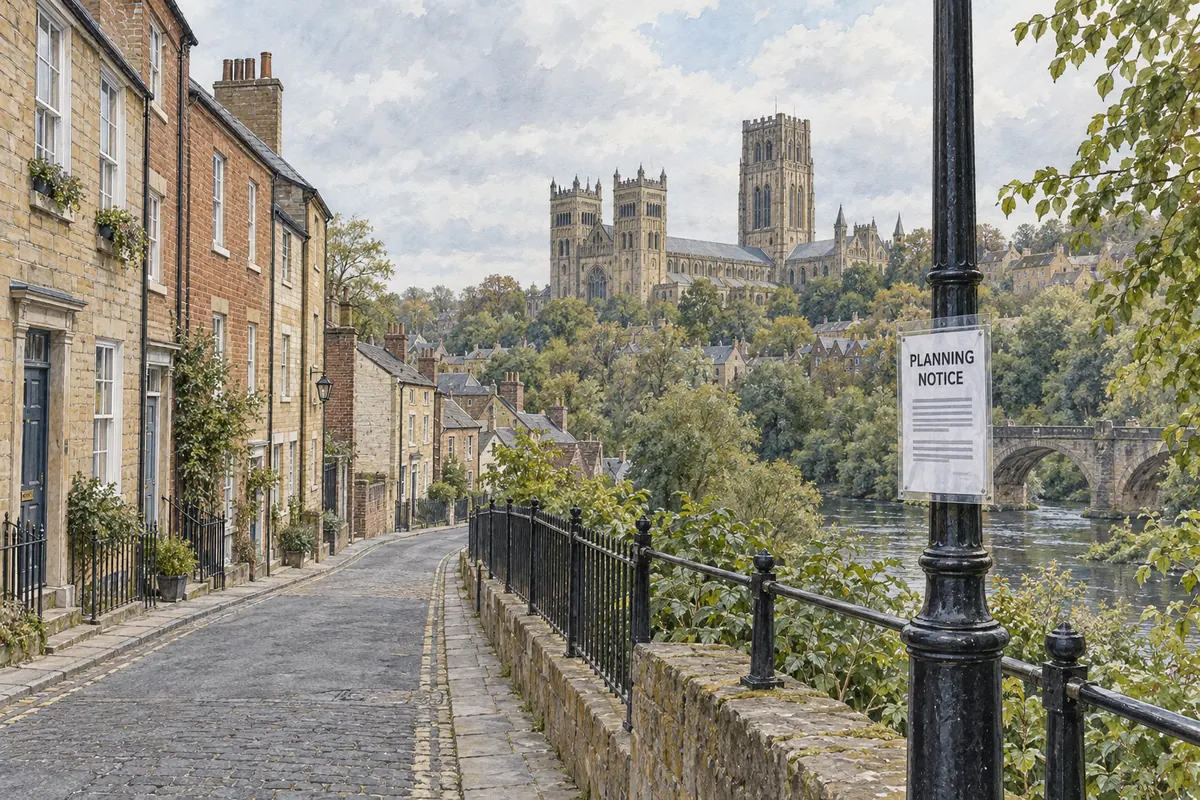
The short answer: eight weeks from validation, often longer
In England, a local planning authority is expected to decide a householder application, which covers extensions, loft conversions, outbuildings and most other work to a single house, within eight weeks. Major applications have thirteen.
For County Durham the planning authority is Durham County Council, a unitary council covering the whole county. Darlington, Hartlepool and Stockton-on-Tees each have their own council, so an address in those areas is decided elsewhere.
Eight weeks is a target, not a promise. The period runs from the day the council validates the application, not from the day you submit it, and the council can ask you to agree an extension of time. Complete, uncontroversial applications within policy often come back inside the eight weeks; those that need amendments, attract objections or go to committee take longer. Add the two to three weeks needed to prepare the drawings and a realistic allowance for the planning stage as a whole is eight to ten weeks.
Validation: the clock does not start when you press submit
Before an application is registered and the eight weeks begin, the council checks that it is valid: that it contains everything on the national list of requirements and on Durham County Council's own local validation list, which it publishes on its planning pages and updates from time to time, so check the current version before you submit. If anything is missing, the application is not registered and the clock does not start until it arrives.
The most common reasons householder applications bounce at validation are:
- no site location plan, or one without the site edged in red on an Ordnance Survey base at a recognised scale;
- missing existing drawings, since the council needs to see the house as it is;
- elevations or floor plans without a scale bar or a stated scale, or drawings that are not to scale at all;
- the wrong ownership certificate, or none, on the application form;
- the application fee unpaid or paid at the wrong rate;
- a missing supporting document the local list asks for, such as a heritage statement in a conservation area, a tree survey, or a flood risk assessment in a flood zone.
A week lost at validation is a week added to the whole programme. An agent who submits applications regularly knows the local list and prepares the pack to it.
The 21-day consultation
Once validated, the council publicises the application: letters to the immediate neighbours, sometimes a site notice nearby, and notification of the parish or town council and any statutory consultees the proposal affects, such as the highways team if you are altering an access or the conservation officer in a conservation area.
Each of these has 21 days to respond, and the council cannot decide the application until that period has passed. The case officer uses the same three weeks to visit the site and check the drawings against policy. Comments from neighbours count only if they raise planning matters: overlooking, loss of light, overbearing impact, parking. Objections about lost views or property values carry no weight.
If the case officer has concerns, this is typically when you hear about them. A request for a small amendment, a reduced depth or a change of window position, is common, and agreeing it quickly keeps the application moving.
Why the council asks for an extension of time
Councils are measured on the share of applications decided within the statutory period or within an extension agreed with the applicant. When an officer can see that the eight weeks will pass before a decision is possible, they will usually ask you, or your agent, to agree an extension of time in writing, and the application counts as on time if it is decided by the new deadline.
The reasons are mostly practical: amended drawings need a further round of consultation, a consultee has not responded, the application is going to committee and the next meeting falls after the deadline, or the officer has a full caseload. The choice is straightforward: agree the extension, or refuse it and force a decision on the application as it stands, which, if the officer has unresolved concerns, may well be a refusal.
If the deadline passes with no decision and no agreed extension, you can appeal to the Planning Inspectorate against non-determination. For a householder this is rarely the quickest route, because an appeal takes longer than the council would have.
Delegated decisions versus planning committee
The large majority of householder applications are decided by planning officers under delegated powers. The case officer writes a report, a senior officer signs it off, and the decision notice is issued. This is the quick route and it is where most extensions end up.
An application goes to a planning committee, a public meeting of elected councillors, when the council's scheme of delegation says it must: typically a request from a local councillor, a parish council objection that runs against the officer's recommendation, a set number of public objections, or an application by the council itself. Durham County Council decides most householder applications under delegated powers; those that do go to a planning committee wait for the next scheduled meeting, and the dates are published on the council's website.
Committee adds time in two ways: the application waits for the next meeting after the report is finished, and the committee can defer a decision for a site visit or more information. Committees usually follow the officer's recommendation, but not always.
What happens after a refusal
A refusal is not the end. The decision notice sets out the reasons, each tied to a policy, and those reasons tell you which of two routes makes sense.
- Resubmit. If the reasons can be addressed by changing the design, reducing the depth, lowering a ridge, moving a window, a revised application is usually faster than an appeal. A resubmission is a fresh application with its own council fee: the old free resubmission within twelve months of a refusal was withdrawn in England at the end of 2023. Allow another eight weeks.
- Appeal. If you believe the council has applied its policy wrongly, you can appeal to the Planning Inspectorate. Householder appeals must be lodged within twelve weeks of the decision notice and are dealt with by written representations, with no hearing. There is no charge for lodging the appeal. It is decided on the scheme as refused, so the design cannot be amended along the way, and it takes considerably longer than the original application.
Before submitting anything, a good agent will tell you whether a proposal is likely to be refused. Where the design is contrary to policy, the honest advice is usually to change it first.
How to shorten the process
You cannot make the council decide faster, but you can remove every avoidable delay from your side.
- Check the constraints first. Before any drawings are produced, find out whether the house is listed, in a conservation area or a flood zone, has protected trees, or has lost permitted development rights through an Article 4 direction or a condition. Each changes what is likely to be approved and what documents are needed. Our planning permission guide covers the common projects and the extensions page sets out the limits that decide the route.
- Submit a complete drawing pack. Scaled existing and proposed plans and elevations, a block plan and a location plan on a licensed OS base, the right certificate on the form and the fee paid. The example project packs show an approved planning set.
- Design within policy. An extension that sits inside the council's guidance on depth, height, spacing and materials is most likely to be a delegated approval. Pushing the limits invites amendments, objections and committee.
- Consider pre-application advice. Durham County Council offers a chargeable pre-application advice service where an officer gives an informal view first; response times vary, so build it into your programme. For a straightforward extension it is rarely needed; in a conservation area, on a listed building or outside the normal limits, it can save a refusal and a second application.
- Talk to the neighbours. Showing them the drawings before the council's letters arrive removes surprises, and fewer objections mean less chance of committee.
- Respond fast. When the officer asks for an amendment or a document, the days it sits in an inbox are added to your programme, not the council's.
- Use an agent. Someone who submits applications regularly knows the local list and the likely sticking points, and handles the correspondence so nothing waits. Our planning permission drawings service includes this.
Planning permission and building regulations approval are separate. The building regulations drawings can be prepared while the application is with the council, which shortens the overall wait, but starting on site before the planning decision is at your own risk.
Frequently asked
Does the eight-week period start on the day I submit?
No. It starts once the council has validated the application, having checked that every required drawing, form, certificate and fee is present. Time spent waiting for missing items is not counted.
Can I start building while I wait for a decision?
You can, but entirely at your own risk. If the application is refused, or approved with a condition you have already breached, the council can require the work to be undone. Most builders will not start without the decision notice.
Should I agree to an extension of time?
Usually, yes. Refusing it does not speed the council up; it forces a decision on the scheme as it stands, which may be a refusal if the officer has outstanding concerns. A short extension to allow an amendment or a late consultee response is nearly always the better bargain.
How long does a planning appeal take?
Considerably longer than the application itself. Householder appeals use the written representations route, the quickest the Planning Inspectorate offers, but its average timescales change from year to year and are published by the Inspectorate. For most homeowners a revised application is faster.
Does a conservation area or listed building make it slower?
Often. The conservation officer is consulted, a heritage statement is usually required, and on a listed building a separate listed building consent application runs alongside. The target period is the same, but an extension of time is more likely.
How CR Design help
CR Design Services are Durham-based architects and structural engineers under one roof, and Durham County Council is our local planning authority. We carry out site visits, planning and concept design across the North East, and prepare building regulations drawings and structural design nationwide. We check the constraints before any drawings are produced, prepare a complete pack with a licensed OS location plan, and act as your agent with the council from validation to decision. The instant quote tool gives a fixed figure for each stage, and our process page shows how the planning stage fits into the whole project.
You might also find useful
Thinking about a project?
Tell us what you have in mind and we'll talk you through the right route, the likely stages and what to expect, with architecture and structural engineering under one roof.