
Crack monitoring: why we measure for 12 months before deciding
A single inspection shows a crack as it is on the day. It cannot show whether the movement has stopped, comes and goes with the seasons, or is still getting worse. Monitoring answers that question with measurements rather than guesswork.
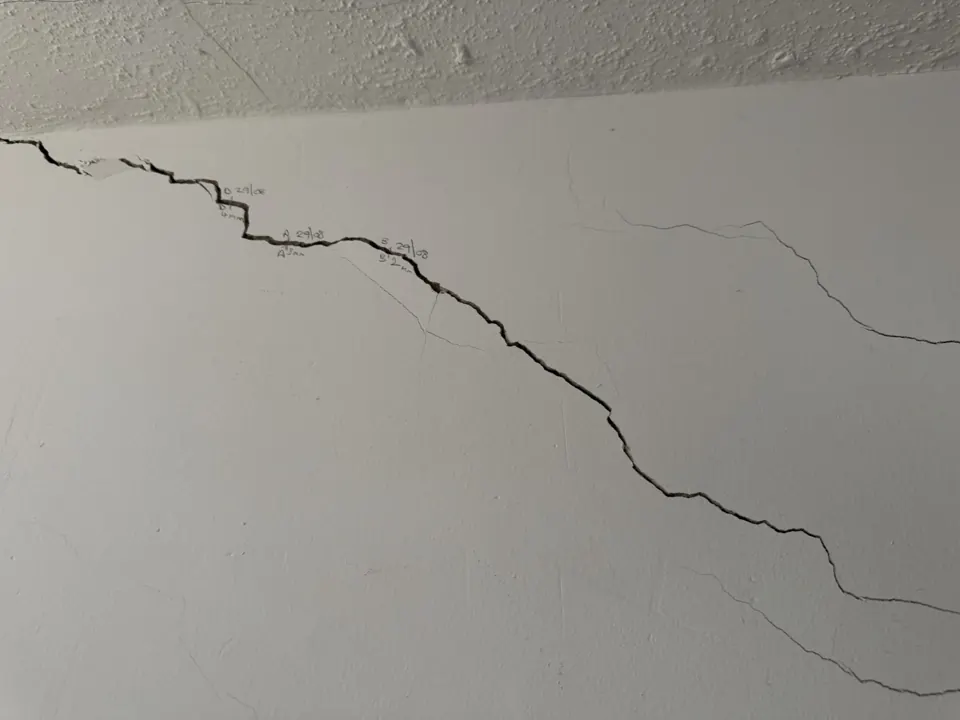
Crack monitoring is one of the most common recommendations to come out of a structural condition survey. It is also one of the least understood, because the honest answer it gives — “we will know in a year” — is not the instant verdict most people hope for. This guide explains what the monitoring involves, why it takes 12 months, and what happens at the end.
What crack monitoring is
Small metal studs are bonded to the wall either side of each crack. The distance between them is then measured with digital callipers to an accuracy of 0.1mm, and the readings are repeated at regular visits — monthly, six-weekly or quarterly — over 12 months. The studs are glued in place with no drilling into the brickwork, and they are small and discreet. The method follows the guidance in BRE Digest 343, which is the standard reference for monitoring building movement.
Why 12 months, not three
Clay soils shrink as they dry in summer and swell again through the winter, and nearby trees exaggerate that cycle. A crack caused by seasonal ground movement can close up entirely for months at a time. Measure for only part of the year and you risk catching the closing half of the cycle and wrongly concluding the movement has stopped. Twelve months covers a full wet and dry cycle, which is what makes the conclusion reliable. There is more on how trees drive this cycle in our guide to trees, clay soils and subsidence.
The results decide what happens next: whether simple cosmetic repairs are enough, or whether further investigation and structural work are needed. Many insurers also require monitoring evidence before agreeing a subsidence claim, so the readings have a practical value beyond the engineering.
What is involved, visit by visit
We install the studs and take the first readings on an initial visit. Each visit after that takes around 30 minutes and needs access to every monitored crack, inside and out. We recommend a visit frequency — monthly, six-weekly or quarterly — based on how active the movement looks.
Two things protect the value of the exercise:
- Please do not fill, repoint or redecorate over the monitored cracks while monitoring is running.
- Please do not disturb the studs — missed or disturbed readings reduce the reliability of the results.
What it costs
| Item | Fee |
|---|---|
| Monitoring visits — monthly, six-weekly or quarterly, including installing the studs on the first visit | £150 + VAT per visit |
| Final report with our opinion on whether movement is ongoing | £450 + VAT |
| Example: a year of monthly visits (12 × £150) plus the final report | £2,250 + VAT |
Fewer, longer-spaced visits reduce the cost of the year — quarterly monitoring needs only four or five readings — and we will recommend the frequency that suits how active the movement appears.
The three outcomes, and what each means
| Result | Typical next step |
|---|---|
| No significant movement | The movement is historic. Cracks can be repaired and redecorated. |
| Seasonal movement | Cracks open and close with the seasons, often due to trees or clay soil. Tree management first, then repair. |
| Progressive movement | Cracks continue to widen. Further investigation — drains, trial pits, soil testing — and possibly foundation repairs such as underpinning. |
It is worth saying plainly: most monitored cracks do not end in underpinning. The most common outcomes are reassurance or a modest, targeted repair — which is exactly why it pays to measure before anyone reaches for a structural solution.
Next steps
At the end of the 12 months we issue a short report confirming whether movement is ongoing, seasonal or stopped, with recommendations for repair. If subsidence is suspected, contact your buildings insurer before monitoring starts, as they may wish to appoint their own engineer. And if you are at the earlier stage — a crack you have just noticed and no advice yet — start with our guide on what to record and when to get a structural survey.
Guidance for homeowners in England. Costs are indicative at 18 October 2026 and depend on the property and ground conditions. Reviewed 18 October 2026.
You might also find useful
Worried about a crack that keeps coming back?
One of our structural engineers can inspect it, set up monitoring if it is genuinely needed, and tell you plainly what the readings mean. Fixed-fee inspections from £490+VAT.